When Beethoven rehearses
Interview |

"I don't want to see a Fidelio set on the German-German border, for example. In other words, a production that tells the story of a very specific political or social situation. In my opinion, Fidelio only works if it is kept general." This is how director Nikolaus Habjan outlined initial ideas for his "Fidelio" production a year ago. Now the time has come, rehearsals have started and the premiere of Beethoven's only opera is just around the corner. Nikolaus Habjan spoke to Oliver Láng about why Leonore and Florestan are doubled with puppets, how evil Don Pizarro really is and why Rocco is ultimately a character worthy of appreciation.
A few days ago, a television report on Albrecht Dürer described how much he explored the world through his drawings. Do you feel the same way as a director? Do you learn something about our lives through your productions, through characters like Leonore and Rocco?
That's a very good question. So: definitely yes. For me, my work as a director, but also as a puppeteer, is a great exploration of existence. By bringing phenomena of life and society to the stage, I get to know the world. Especially when it comes to big, topical issues and moral action, as in “Fidelio”.
We'll come to the current and moral issues in a moment. But first, because I've just seen you so incredibly committed and happy in a work situation: Is the intensive tinkering with individual gestures, words and nuances at the beginning of the rehearsal phase the best thing for you? Because everything is still open?
Yes, I love that! Because in these early rehearsals we can examine the characters together from top to bottom and analyze them in detail. It's nice to examine words and notes again and again, to turn them around and look at them from different angles. I always start rehearsals by singing through the scene once so that we can start working with the music in our heads: What does it tell us? What does the conductor think? Then I bring in my thoughts, impulses come from the singers, intuitive things. And then there are always those special moments when my ideas and those of the others and Beethoven's music come together at one point. That is immensely satisfying and a palpable joy for everyone. But that doesn't mean that other phases of the work aren't just as enjoyable. Or the result. It's wonderful when you're sitting in a performance and, as an audience member, you simply understand why which character is doing something and everything seems completely coherent and natural, with no deliberate concept shining through. I always say: the best moments are when you don't feel the direction.
What was already apparent in the preliminary talks was how well you know the piece inside out. Every instrumental entry, every comma.
Which, in my opinion, is simply the director's job. It's essential to know the work you're working on down to the smallest detail.
How clear is the picture you have in front of you before a rehearsal? Is there a director's book in which everything is already written down? Or is it more about a general route?
I always have a plan that includes not only the general direction, but also a lot of detail. But - and this is crucial - I'm always prepared to abandon this plan if something better comes up during rehearsals. It doesn't matter whether I come up with something good or someone else does. I don't have an ego problem with that. After all, a director's job is not just to find a scenic path, but to bring everyone together and develop the best possible solution.
Earlier, at the end of the morning, you said: "Now Beethoven was just in rehearsal!" What did you mean by that?
By that I meant one of those moments I mentioned earlier, when everything comes together and everyone pulls together. You can really feel it: the way we put our heart and soul into it, Beethoven would like it, because his music is interwoven with the scene. It's as if he was there. You must never forget that he was a great lover of the theater, a theater enthusiast, someone who was interested in the theater, who worked on many stage texts and wrote incidental music. Accordingly, one often encounters clever scenic decisions in his compositions. He was more than "just" a composer.
The Vienna State Opera has said goodbye to a production that was in the repertoire for 55 years and was influential for many. As a director, do you have to work your way through this old setting? Or do you simply do your Fidelio, regardless of what happened?
The second! I don't have Otto Schenk's work in my head all the time and then deliberately do it differently. That's not the point at all. Just as it's never about provoking anyone who liked the production. But rather: This production has been performed over 250 times since 1970. And that is simply a very long time for a work. And it's in the nature of opera and theater that we renew things. Of course, I have studied Fidelio at the Staatsoper, its performance history, and thought about what I can incorporate into my production. Also from the point of view of: what have I perhaps already dealt with in other pieces? In my play about Karl Böhm, for example, I dealt with him - I don't have to include that in the Fidelio production.
How politically specific is your work? Do you refer to certain historical moments that should be recognized? Do you locate Fidelio in a real existing or a former dictatorship?
No, that would make the work smaller. If you think about what Beethoven wanted with his works, you always come across a great idealization. And such an idealization stands above a specific epoch. That's why I want to create something that is ultimately independent of time. The less I try to set the plot in a narrow, temporally or politically precise situation, the more timeless the work becomes. It's about the big themes that Beethoven deals with, and you can understand them quite clearly without using a historical frame of reference.
In your work, however, these major themes are not only love, courage and liberation, but also the transformation of a seemingly minor character: Rocco.
I think the most important thing in the play is Rocco, who is actually the main character. Because he is the only character who goes through a development. That's why I focus on him in particular. By the way: Rocco is also timeless.
Rocco, then. He is not a popular character. Nevertheless, you judge him much more positively than he comes across in many other productions. He is a classic hanger-on, with an unpleasantly pronounced penchant for money.
When we look at our world, we are all followers. Even the best of people have run along somewhere, and none of us can exempt ourselves from this. Nor should we fall prey to the misconception that Leonore is the figurehead of opera. Because she is not. She is a role model, but the identification figure is Rocco. Leonore is an archetype, the heroine. Rocco, on the other hand, is a man with weaknesses, with greed, fear, cowardice, and he is endowed with moral pathological flexibility. And yet: he makes a small switch by no longer allowing himself to be influenced by Pizarro, but by Leonore. It is a small, easily overlooked decision. But it is one that - if we think bigger - can also change our world for the better.
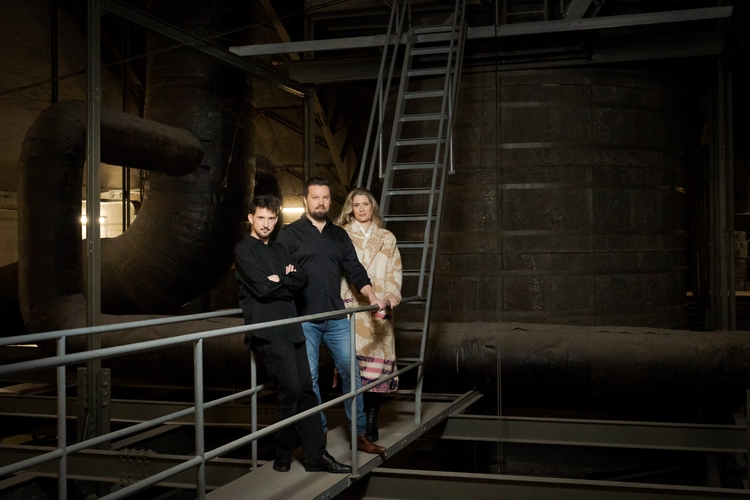
So Rocco is the lesson that you can take with you.
I think when you tell people: You have to be a heroine now!, then that just intimidates them, they fall into a state of shock and nothing happens. But if you say: You don't have to be perfect, but just pay attention to what you allow to influence you, that can change a lot. Then someone might think: Yes, I'd rather listen to Fidelio and not Pizarro. Small decision - huge consequence.
What about Jaquino? In your production, he brings a lot of aggression and pressure into play. Is he still a little Rocco with a chance to do better or is he already a Pizarro?
With Pizarro it is a matter of life and death, he is on the verge of collapse and he wants to save himself by an extreme act - the murder of Florestan. Jaquino, on the other hand, I see from Marzelline's point of view. Here is a woman who previously had no other chance than to marry Jaquino, which she would have done with a fatalistic indifference. Suddenly, however, she sees freedom, hope and great love through Fidelio. Jaquino is now absolutely unthinkable for her, and even more: she sees the idea of marriage with him as a threat, as a threat. It is not for nothing that she sings: "I was scared to death." In addition, her father Rocco also has feelings for Fidelio and has also fallen in love with him on some level. Jaquino, who was already sure of his marriage, realizes how things are slipping away from him. Hence his panicked aggression, he tries to keep Marzelline - and suddenly everything escalates.
Back to Pizarro. Is he just a driven man? Or as absolutely evil as Iago, Hagen, sadistic like Scarpia?
For me, Pizarro is a little coward, severely narcissistic, without empathy, someone who always tells himself he's great. He makes this clear calculation: if it is discovered that Florestan is imprisoned, my existence is at risk. So Florestan's existence must be destroyed, with all the evidence. So it's not about a planned murder, but about the fear of being convicted. It's also important to me to show his two-faced nature, because Pizarro can appear very different: In the few moments when he is in the public eye, I want to show him as sympathetic as possible, but behind that is a puny human being. Unfortunately, he's in a position where he can cause a lot of suffering.
"I have often experienced the final cheers being sabotaged a little or cast in a dystopian light. But that's simply not possible with Beethoven's music."
You spoke of the idealization engine that drove Beethoven. And that's how you have to see the character of Leonore: A heroine who does everything she can to save the person she loves. But what - provocatively asked - is the truly exemplary great deed? She disguises herself, and at the decisive moment of confrontation with evil, she is clearly better armed than Pizarro. A Tosca is just as willing to do many things to save her lover as many others. But we sing Leonore's praises.
Of course, this is also due to the times - and the great idealization that is involved, which you have to learn to deal with and allow. I have often experienced that the final jubilation was sabotaged a little or cast in a dystopian light. But that simply doesn't work with Beethoven's music. Apart from that, I think it's definitely worth a try to say: let the happy ending happen and let people celebrate. That's nice too.
But can't the jubilation also take on something official, in the sense of: Now people are rejoicing, there is an authority again, this is the new direction?
The nice thing is that the minister doesn't actually play any role at all, or only the one that scares Pizarro. Before he can finish, Rocco runs into him in the middle of his speech, and Leonore is given the moment at the end to free her husband from his shackles. I really like the fact that Beethoven has created this spherical moment, which is followed by jubilation. It is Florestan who says that he could not have done it without his wife, not the king's voice. So it is less about a "from above" and more about a "from man to man".
What does Leonore think of all this jubilation? She becomes the new ideal. In your production, this can even be experienced visually.
In everything we do, it can happen that an uncontrollable independence suddenly occurs. This is the case with Leonore's disguise, when Marzelline falls in love with her, and it is the case at the end of the opera, when Leonore becomes a symbol of liberation from political oppression. She personally is not interested in such things. After Florestan's liberation, the story is told for her. What happens after that is much more important for the others.
In this production, you use large puppets to complement the Leonore-Florestan couple. Are you no longer able to escape puppetry, which is an important part of your work? Or do you use the puppets because you can show something that would otherwise be much more difficult to convey?
When I use dolls, there always has to be a clear added value for me. Let's take Leonore: We have a woman who, disguised as a man under the name of Fidelio, wants to save her husband. Now she is in a perpetual conflict between the most intense emotionality and the pressure to conceal her identity. This is very exciting on a dramaturgical level, but is extremely difficult to portray on stage. In our case, I split the character up: the singer Malin Byström embodies Leonore's inner emotional world, and the puppet is what the others get to see: a controlled, reserved Fidelio. In this way, I can show all the tensions that arise from the disguise and trace emotional states much more precisely. For example, how Leonore's heart breaks as soon as she realizes what she is doing to Marzelline - but she does it anyway because she has a greater goal in mind. We can show this struggle very clearly with the combination of human and puppet. This is sometimes unusual for singers at first, but in the course of rehearsals it always becomes clear that we don't lose 50 percent of the acting, but have two hundred percent: One hundred percent human, one hundred percent puppet.
But why are you doubling Florestan? He is always just one person, never disguised, never in disguise.
Paradoxically, this has to do with the attempt to make the game more realistic. With a puppet, I can show the traumas of the prisoner more precisely, I can portray a character who vegetates in the dungeon for two years in complete darkness, almost without food. So we have the singer -
that is Florestan, as Leonore remembers him. And we have the puppet -
that is the prisoner after two years in prison. There are also many reports of people who were buried or survived in inhumane imprisonment and distanced themselves from themselves in this situation. This is a well-known psychological process that I can show in the theater thanks to the puppet. It also creates the opportunity for Leonore and Florestan to encounter each other on a newly visible emotional level.