Three strong women
Interview |
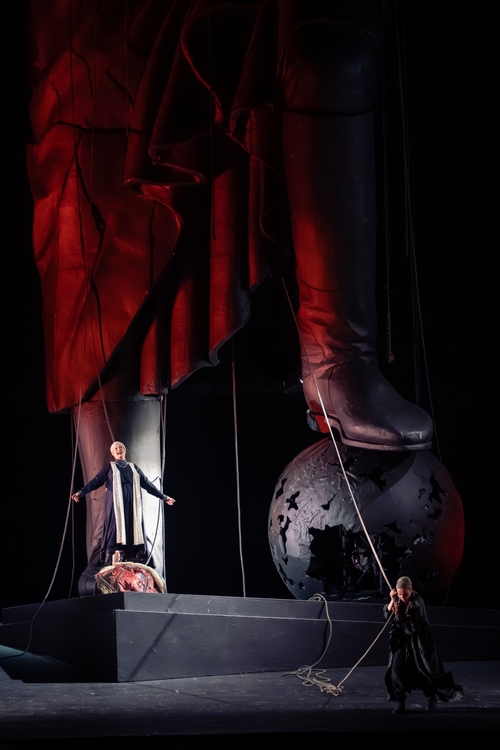
Once again, things get pretty brutal: Agamemnon sacrifices his eldest daughter, Iphigenia, and then goes off to war. The mother, Clytemnestra, takes a lover - together they murder Agamemnon on his return. The son Orest flees the palace for his own safety; his sisters Electra and Chrysothemis stay behind. Burning with hatred and a thirst for revenge, Electra awaits the return of her brother, who is to avenge her father's murder by killing her mother. - This is the rough outline of Elektra, a one-act opera by Richard Strauss and Hugo von Hofmannsthal based on the Atrides saga. It is a play that forces performers and audience alike to look into the abysses of human existence. The focus is on three female characters - Elektra, Klytämnestra and Chrysothemis, whose complexity and intensity are more powerful than in almost any other opera. For the revival at the Vienna State Opera, Aušrinė Stundytė and KS Camilla Nylund return in the roles of Elektra and Chrysothemis. KS Nina Stemme plays Klytämnestra for the first time. The sopranos talk to Rebecca Sophie Mayr about the depths of the work and their relationship to their characters.
Ms. Stundytė, Ms. Nylund, Ms. Stemme, Strauss' Elektra is not new to any of you. You have interpreted the piece many times, including here at the Vienna State Opera. Do you remember your first encounter with the work?
AS: When I was still a student - and a big Puccini fan - I once saw a video of Elektra. I don't remember the production exactly, but I do remember that I didn't like it at all. The music seemed wild to me, the story too brutal, and I was convinced that I never needed to see this opera live. Fast forward about fifteen years: I was offered the role of Chrysothemis and my Elektra was Irene Theorin. Her voice took me completely by surprise - suddenly this murderous world sounded beautiful. Then I thought: "Okay ... maybe I was wrong. I would actually like to sing that one day."
CN: I actually saw Elektra staged in Japan once. Of course, I was already familiar with the play and the title character's insane role. But I only really got to grips with it in my first production. That was in Amsterdam in 2011, directed by Willy Decker, with whom I had already worked several times before that. The first production in a new role is of course always very formative. And then these female characters in their constraints and hopeless situations - that's very touching.
NIS : I was in Vienna for an audition with the director at the time, Ioan Holender, and I really wanted to hear the acoustics in the hall beforehand. So I went to the Kupfer-Elektra the evening before, of all places. It was very impressive, but I didn't speak German very well at the time and I can't say that I fully understood what it was all about. But I remember an incredible intensity on stage and of course I could never have dreamed back then that I would one day sing Elektra and Klytämnestra on the same stage.
"This special connection between Strauss and Hofmannsthal and Vienna creates a very unique atmosphere."
Ms. Stemme, this revival is a very special occasion for you, because you are now making your debut as Klytämnestra, about ten years after you also made your Elektra role debut at the Vienna State Opera. Did this happen by chance, or did you plan it that way?
NIS: Well, back then I was of course constantly making role debuts in new productions. But now for Klytämnestra - after my Ortrud debut in 2023, I knew that I would get very good support here in Vienna. And then there is also this special connection between Strauss and Hofmannsthal and Vienna - that creates a very unique atmosphere.
How does it feel to carry a piece or a role with you for so long?
AS: The great thing about Elektra is that it never gets boring. I never get to a point where I think, "Yes, now I understand her completely." Greek tragedies deal with these great human archetypes - loyalty, revenge, trauma, love - and they live somewhere in all of us. When I change, my Elektra changes with me. It's like opening an old diary again: suddenly you notice things that you overlooked before. That's why it remains so exciting.
CN: Exactly, some things naturally change over time: you approach the part differently, sing it differently. That's because you continue to grow in between, of course, singing other parts, including more dramatic parts in my case. The lyrical parts that Chrysothemis has to sing then become somewhat easier. I remember that I found the role very strenuous at first, even though it's not a particularly long part. In the long run, you learn to rise above it better.
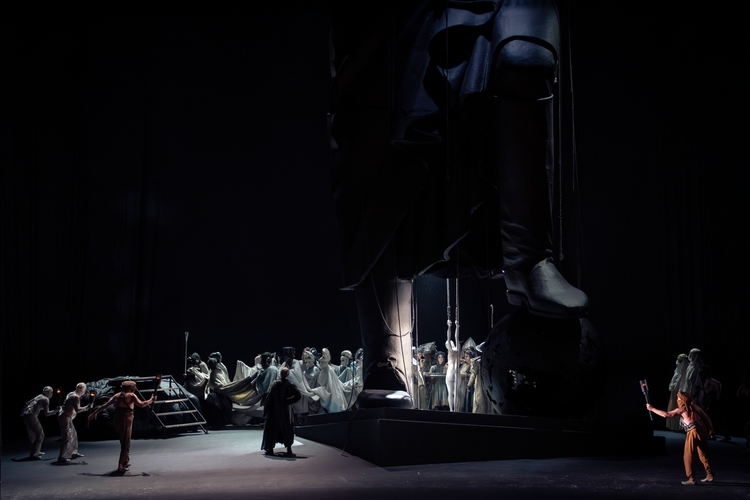
Ms. Stemme - same play, new role: Are there also continuities or changes?
NIS: I've always had a certain love-hate relationship with Strauss' music in a good sense. He's really brilliant in terms of his craft - almost too brilliant. A bit like Puccini. He knows exactly how to treat the singers, especially the sopranos, but also the audience. But then, when I've learned my part, I'm totally open. Then Strauss' music really gets under my skin. The change from Elektra to Klytämnestra just happened for me. My voice feels more comfortable in a lower register; I also think that my stage and life experiences are perhaps better suited to the mother role now. But the intensity and enthusiasm for the play in general remains absolutely intact. Elektra in particular is inexhaustible in this respect.
Elektra is an extreme play in all respects. Murder, revenge, hatred, guilt, family traumas ... All these things play a major role. How do you mentally adjust to such a subject?
NIS: The gravity of the subject matter naturally takes its toll on you. In my preparations at the moment, for example, I think about death almost every day, because this incredible fear of death is a central theme for Clytemnestra. She actually knows that she is going to die, but she represses it, tries to keep it from herself. Strauss and Hofmannsthal put all this into the text and the music, into the way they deal with musical themes and motifs. Clytemnestra keeps trying to suppress her memories, but then they burst out unexpectedly - this is reflected musically. I think that a great deal takes place in the subconscious - in the sense of Freudian psychoanalysis. This is certainly also due to the time the opera was written.
CN: Yes, this great fear - I think that's also a main theme for Chrysothemis. She is not a driving character in the play, but her difficulty lies in the fact that she is always caught between everyone. In the first dialogue, she tries to dissuade Electra from her course of revenge. On the other hand, she is afraid of her mother, of Clytemnestra's unpredictability and of the terrible things that happen in this palace. She is so lost there and doesn't know what to do with herself, except that she wants to leave and hopes that everything will be all right. And in the end, Elektra dies and she is left all alone.
The other difficulties of the play are, of course, the musical demands: Chrysothemis is not on stage all the time like Elektra, but because of these two short scenes, because of this in and out, you actually have to acclimatize yourself again and again. It feels incredibly stressful, and I think that's perhaps something that Strauss wanted to create - this constant stress that Chrysothemis is under.
AS: I think it's impossible to really "identify" with this situation - fortunately! Instead, I try to understand the message: No one in this family is innocent. Everyone has a reason, everyone is hurt, and everyone believes that revenge will fix everything. What the story doesn't offer is a way out. The spiral of violence has no end, it only continues to escalate. This is perhaps the most disturbing aspect: the tragedy unfolds not only because of the evil, but because none of the characters are capable of forgiveness. It is the opposite of a Hollywood ending. Greek tragedy denies us catharsis through happiness - and instead forces us to confront ourselves. You walk away thinking, "This could have ended differently if someone had made a different decision."

What about the culpability of the characters? So this "it could have ended differently if ..." - is this a freedom of action that these characters anchored in myth can claim at all?
AS: As I said before, in this mythology everyone is to blame - and everyone believes their actions are justified. In this sense, Elektra is perhaps the most "innocent" member of the family. But the question remains: why has she waited all these years without acting? Why does she only act when she learns of Orest's death? Would she really have gone through with it? We will never know. Her only tangible crime is psychological torture - the relentless emotional violence against her mother. In Greek tragedy, passivity can be just as destructive as action.
NIS : In Clytemnestra's case, of course, you have to consider the back story: Agamemnon had their daughter Iphigenia killed as an offering to the gods. In this respect, I do think that Clytemnestra feels justified in her revenge on Agamemnon. I mean, there is nothing worse imaginable than your own husband murdering your daughter. And then, after the Trojan War, he returns home with a new lover! But well, murder is murder, of course, and I think that when Clytemnestra talks to Electra about having sent a lot of gold to Orest, she is perhaps also trying to clear her conscience. But at the moment, I would like to focus my interpretation on this question of repression, which we have already talked about, and what it means when all these repressed feelings suddenly come up again.
Perhaps a brief digression on the other Strauss one-act opera: Salome was the direct predecessor to Elektra, and you all also played this title role. How do you feel about the musical and vocal differences between the two works?
CN: Well, Salome is, how can I put it, musically much more flowery than Elektra, even if the content is of course just as terrible. I love playing Salome. You have a lot of scope for development on stage and really wonderful things to sing. And there are lots of nuances that you can let shine through, for example in the relationship with Herodias' mother - the family difficulties exist here just as they do in Elektra. But in general, Salome is definitely not as much of a tour de force as Elektra.
AS: I feel the same way. Singing Salome feels like a fast, flashy sprint - lots of glitter, lots of adrenaline, big finale. Elektra is a marathon in heavy shoes. The orchestra is huge, the emotions are enormous and you really have to pace yourself. Salome wants to shock you, Elektra wants to get under your skin. You can "perform" Salome vocally - Elektra demands everything from you and then wants even more.
Strauss writes in his memoirs that Elektra relates to Salome like the more accomplished, stylistically unified Lohengrin to the brilliant first draft of Tannhäuser. Would you agree with this?
NIS: Yes ... but perhaps it had to be that way because the two pieces are also very different. That was also an issue for Strauss. He wasn't entirely convinced when he saw Hofmannsthal's play Elektra . He had reservations as to whether it was too similar to Salome, because both plays place such a female figure at the center. But that's not true at all. Salome is musically very strongly influenced by Tristan and Isolde . The title character is younger, more lyrical, much more impulsive, whereas Elektra is very purposeful. Her whole life depends on this revenge, and when it is carried out, her life ends. In this sense, Elektra is more of an idea than Salome - so perhaps a little more unified.
"They are messy, emotional, complicated women trying to get through a terrible situation."
From Salome onwards at the latest, Strauss always places female characters at the center of the plot. A brief digression into popular science: in film and literature, the so-called Bechdel test is often used as an indicator for the representation of women in works and genres. Three questions are asked: Are there more than two women? Do they talk to each other? Do they talk about something other than a man? Can we therefore say that Strauss and Elektra feature contemporary female characters on stage?
NIS: Yes and no ... It depends on how you interpret them. It is of course a gift that Strauss often wrote for several female leads. As a Wagner singer, you miss that a bit. But the question arises as to why Elektra can't carry out the murder. Is it because she is a woman? Clytemnestra, however, carried out the deed herself, so perhaps it can't be argued that it always had to be the man.
Then, of course, there is the question of children: in Euripides, it is Elektra, rather than Chrysothemis, who harbors the desire for a family and a home. So Hofmannsthal certainly changes the play and places Chrysothemis much more in the "traditional" corner. And I'm sure he deliberately intended it that way, because then we as the audience can ask ourselves what kind of women they are and what they stand for - or what we stand for.
CN: I think Strauss lived at a time when women were beginning to discover their own freedoms. He was also married to a very strong woman who influenced him a lot. Pieces like Der Rosenkavalier in particular feel incredibly contemporary, and he certainly owes a lot to Hofmannsthal's libretti.
From a singer's perspective, it is of course always a revelation to sing Strauss, because he simply wrote so well for the soprano voice. On the other hand, you also sometimes get the feeling that the women in Strauss are forced into a victim role, quite the opposite of Wagner, where the women are actually always more like saviors.
AS: So, technically speaking, Elektra would pass the Bechdel test - many women on stage talk to each other. They don't always talk about men, but they're not "contemporary" women in the modern, feminist sense either. They talk about revenge, honor, trauma, but they are not simple Greek statues either. They are messy, emotional, complicated women trying to get through a terrible situation. This part feels very modern. It's almost scary how familiar their emotions still are.
One last question: Do you have certain rituals for "cooling down", so to speak, after a piece like this? Do you prefer a warm bath or a glass of whisky?
AS: Why choose? A warm bath for the muscles. A glass of whisky for the nerves. Perfect balance.
CN: Well, I don't drink whisky at all. But in Vienna, there's usually someone you know at the show. Then you go somewhere afterwards and talk about the performance. I always find it particularly interesting to hear what people who aren't in the business think about it. I'm not just a singer, I'm also an actress. So I'm interested in how the story as a whole came across.
NIS: Well, I prefer a beer after Strauss. With shorter parts, the adrenaline level usually goes down again more quickly, but with longer parts that demand a lot of energy - Elektra, for example, or Isolde - I like to go home and take a walk. But I'm done with the long parts anyway, I don't regret anything and I don't long to go back. I'd rather move on to the next part.